





 Photography and styling: Tilly Pamment
Images and text from Handfuls of Sunshine by Tilly Pamment, photography by Tilly Pamment. You can buy the book here.
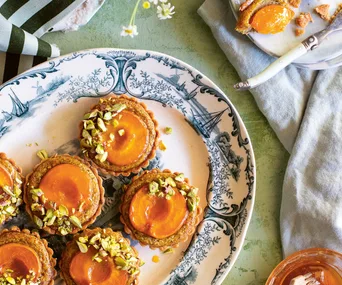
These lemon tarts are sun-shiny little lovelies. They truly are heaven in a tiny tart shell and the perfect foil for a gloomy afternoon. I umm’d and ahh’d about whether or not to include a torched meringue top on these teeny lemon tarts, but decided (much to my kids’ disgust) that I preferred them naked – their mouth-puckering citrus flavour unadulterated.
When making these lemon tarts, do take the time to rub the lemon thyme and zest thoroughly through the sugar at the start of the recipe – this not only ensures a beautifully fragrant, lightly herbaceous lemon filling, but is also wildly therapeutic.
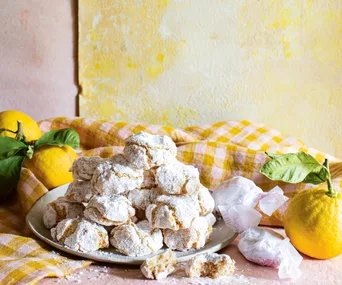
I suggest you use the leftover egg whites for a batch of my Lemon & Fennel Seed Amaretti. Twice the delight!
What is the tart filling made of?
Lemon tarts are usually filled with a silky concoction of lemon juice, lemon zest, eggs, sugar and cream. A pinch of salt helps to balance the sweetness.
How long can you store the lemon tarts?
These mini lemon tarts are at their best on the day they are baked, but will store in an airtight container in the fridge overnight. The pastry will soften a little, and the curd may crack the longer they are stored, but they’ll still be delicious.

Ingredients
Method
First, make the lemon filling by placing the sugar, lemon zest and lemon thyme leaves in a mixing bowl. Use your fingers to rub the zest and thyme through the sugar until the mixture is fragrant and resembles damp sand. Add the whole egg and egg yolks to the bowl and use a hand whisk to mix for a minute or so until well combined. Whisk in the flour and salt before adding the lemon juice and cream, whisking until smooth. Cover and place in the fridge to infuse for at least an hour, or overnight, while you bake the tart shells.
When ready to make the tarts, preheat the oven to 170°C (fan-forced) and place 10 loose-bottomed tart (flan) tins with a base measurement of 6cm, 2cm deep (or equivalent-sized tins) on a baking tray.
Prepare the tart shells by cutting your rested pastry log into 10 equal rounds. Working with one piece at a time, scrunch each round in your hand once or twice to make the pastry malleable, then roll into a ball. Place on a lightly floured surface and, using a rolling pin, roll each ball out to a 10-12cm circle. Gently ease the rolled pastry into the tins, pressing the pastry snugly into the base and up the sides of each tin. If the pastry has warmed up a lot, refrigerate the tart shells for 30 minutes before baking.
Use a small, sharp knife to trim off any excess pastry, then place a square of baking paper or foil into each pastry shell. Fill with baking beads and bake in the preheated oven for 20-25 minutes, or until deeply golden all over.
Remove from the oven and allow the tart shells to cool with the baking beads in them. (This can be done the day before you want to serve the tarts; just store the cooled, cooked tart shells in an airtight container until ready to bake.)
Lower the oven temperature to 120°C. While the pastry shells are cooling, take the lemon filling out of the fridge. Strain the mixture through a fine sieve into a jug that pours well, then use a piece of paper towel to skim off as much foam from the surface as you can. When the tart shells are cool, remove the baking paper and baking beads. Gently pour the lemon filling into the pastry cases. I do this while the tray is in the oven as I find it easier than juggling the tart shells back to the oven filled with the runny lemon filling.
Bake the tarts for 15-20 minutes, or until the filling is just set, but still a little wobbly in the middle. The curd will continue to cook as it cools. Allow the tarts to cool to room temperature before serving, with a dollop of thick cream, if you like.
Short sweet pastry
Place the softened butter in the bowl of a stand mixer with a paddle attachment and mix on low speed until smooth. Add the sugar and vanilla and mix again until well combined. You’re not looking for a light and fluffy texture here, just a uniformly creamy consistency.
Add the egg and continue to beat, now on medium speed until the mixture comes together, scraping down the side of the bowl once or twice. It can take a few minutes for the egg to incorporate, especially if your kitchen is cold, so just take your time here.
Add the flour and salt to the bowl and mix on low speed until the pastry just comes together.
Tip the whole lot out onto a clean work surface and gently bring the pastry and any loose flour together with your hands. Squish and knead ever so slightly until smooth, then divide the pastry in two. Roll each portion into a little fat log. Wrap well and place in the fridge to chill for an hour or two (or up to 2 days), or until the pastry is firm enough to work with. If your pastry has been in the fridge for longer than a couple of hours, leave it out at room temperature for 30-60 minutes before using as directed in the recipe.